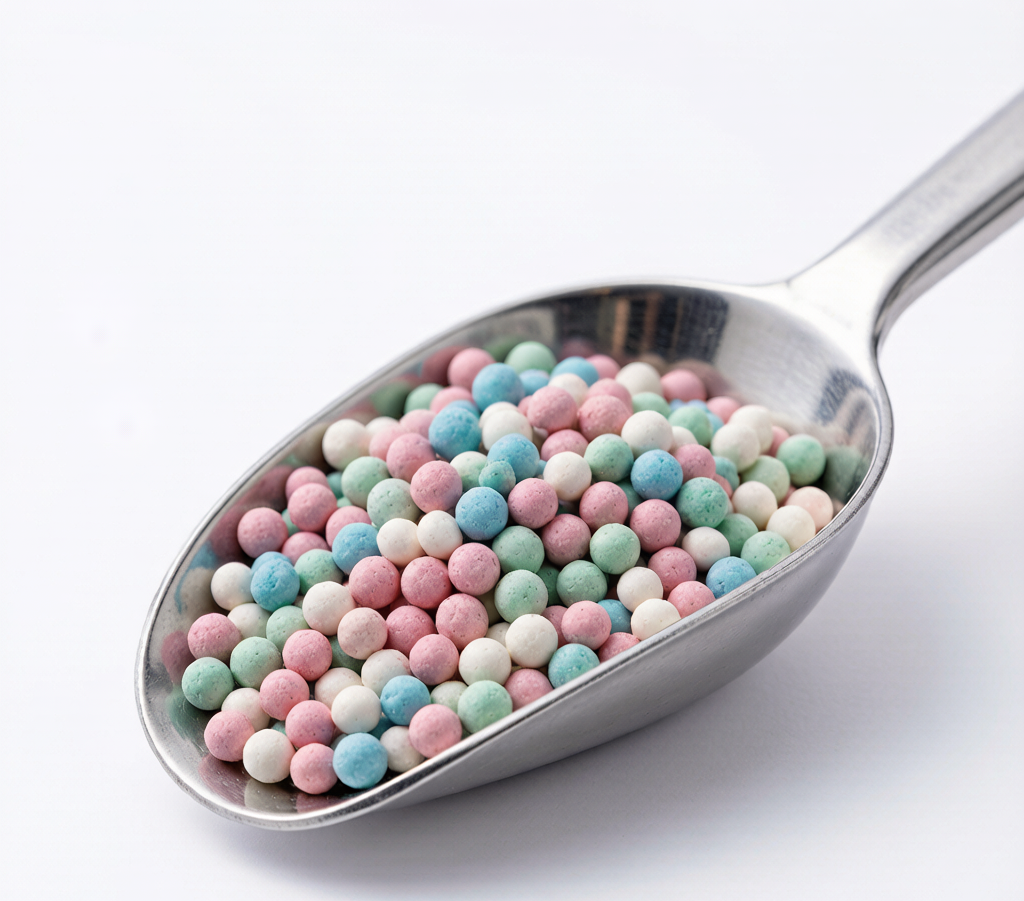
NPK compound fertilizer is a multi-nutrient fertilizer containing nitrogen (N), phosphorus (P2O5), and potassium (K2O) in a single granule. Each granule contains all three primary macronutrients in uniform proportion, ensuring balanced nutrient delivery to crops. Unlike simple fertilizer mixtures (bulk blends) where nutrients may segregate during handling, compound fertilizers maintain consistent nutrient distribution in every granule.
We offer a comprehensive range of NPK formulations including 15-15-15, 16-16-16, 17-17-17, 20-20-20, and many specialty ratios. Our fertilizers are produced using high-tower granulation technology, which ensures uniform particle size (2-5 mm), smooth surface, rapid water solubility, and excellent storage stability. Custom formulations with trace elements (TE) such as zinc, boron, iron, manganese, and magnesium are available for specific crop and soil requirements.
| 15-15-15 | Balanced formula — general-purpose for all crops and soil types (Total ≥ 45%) |
| 16-16-16 | High-analysis balanced formula (Total ≥ 48%) |
| 17-17-17 | Premium balanced formula for high-yield crops (Total ≥ 51%) |
| 20-20-20 | Water-soluble formula for fertigation and foliar application (Total ≥ 60%) |
| 20-10-10 | High nitrogen for vegetative growth stage (Total ≥ 40%) |
| 12-32-16 | High phosphorus for root development and early growth (Total ≥ 60%) |
| 15-30-15 | High P-K for flowering, fruiting, and root crops (Total ≥ 60%) |
| 13-13-21 | High potassium for tuber crops and fruit quality (Total ≥ 47%) |
| 16-6-22 | High K for potassium-deficient soils (Total ≥ 44%) |
| Custom + TE | Custom ratios with trace elements (Zn, B, Fe, Mn, Mg); min. order applies |
| Product Name | NPK Compound Fertilizer 15-15-15 |
| HS Code | 31052000 |
| Total Nutrients (N + P2O5 + K2O) | ≥ 45% |
| Total Nitrogen (N) | ≥ 15% (nitrate N ~7% + ammoniacal N ~8%) |
| Available Phosphorus (P2O5) | ≥ 15% (water-soluble P ≥ 80%) |
| Water-Soluble Potassium (K2O) | ≥ 15% (sulfate of potash or muriate of potash) |
| Moisture | ≤ 2.0% |
| Particle Size | 2.0-4.75 mm (90% min) |
| Appearance | Uniform granules (color customizable: white, pink, green, blue) |
| Chloride Content | < 3.0% (sulfate-based) or as specified (chloride-based) |
| Production Method | High-tower granulation (steam granulation) |
| Water Solubility | 100% water soluble |
| Hazard Class | Non-hazardous (general cargo) |
| Package Type | PP woven bag with inner PE liner / jumbo bag |
| Net Weight | 9.5 kg / 25 kg / 50 kg / 500 kg / 1000 kg jumbo bag |
| Container Loading | ~25-28 MT per 20ft container (bagged) |
| Bulk Loading | ~28-30 MT per 20ft container (bulk) |
| Private Label (OEM) | Custom bag design, brand printing, and formulation labeling available |
| Shelf Life | 24 months from production date |
NPK compound fertilizer is non-hazardous and safe to handle. Store in a dry, covered, well-ventilated area to prevent moisture absorption, caking, and nutrient degradation. Avoid stacking more than 20 bags high. Keep away from strong acids, oxidizers, and food products. Use standard agricultural handling practices. For best results, apply based on soil test recommendations and local agronomic guidelines.
Q: What is the difference between compound fertilizer and blended fertilizer?
Compound (complex) fertilizer has all N-P-K nutrients in every single granule, ensuring uniform distribution. Blended (bulk blend) fertilizer mixes different single-nutrient granules together, which can segregate during handling and spreading, leading to uneven nutrient application.
Q: Can you produce custom NPK formulations?
Yes, we offer custom formulations with any N-P-K ratio and can add trace elements (Zn, B, Fe, Mn, Mg, S). Minimum order for custom formulations is typically 100 MT. Color and packaging can also be customized.
Q: Do you provide OEM/private label service?
Yes, we offer full OEM service including custom bag design, brand logo printing, formulation labeling, and language options. This is popular with distributors who want their own brand on the product.
Q: What is the difference between chloride-based and sulfate-based NPK?
Chloride-based (using KCl) is more economical but should be avoided for chloride-sensitive crops (tobacco, potato, some fruits). Sulfate-based (using K2SO4) is preferred for high-value crops and chloride-sensitive species, and also provides sulfur nutrition.
